The Buddha, without expounding the dharma, is always hearing the sound of the dharma. Without bringing thoughts into his mind, he is all the time enlightening the whole universe. That is the only correct method of reciting this sutra.
And then one asks tentatively: ‘What sort of sutra is this, then, which one recites without holding it in one’s hands?’ Is it not the wondrous law of one’s own mind? And those words: ‘Without raising thoughts in one’s mind, one il- luminates the whole universe.’ What do they signify? Surely, they signify the real, essential lotus blossom. It is what we call ‘the sutra without words’. People who take the golden scroll and its handle into their hands and think that they have taken hold of the Lotus Law, are like sick people who lick the paper on which the medical prescrip- tion is written, and think that that will cure their illness! Such people are in a sad way. If you wish to hold on to this sutra throughout the twelve hours of the day and night, without a single speck of cloudiness or any break within you, then you will have to discipline yourself in the merit- bringing work of non-thinking of good, and non-thinking of evil. This is the correct method.
Image:
Fragmentary Leaf from an
Ashtasahasrika Prajnaparamita Sutra
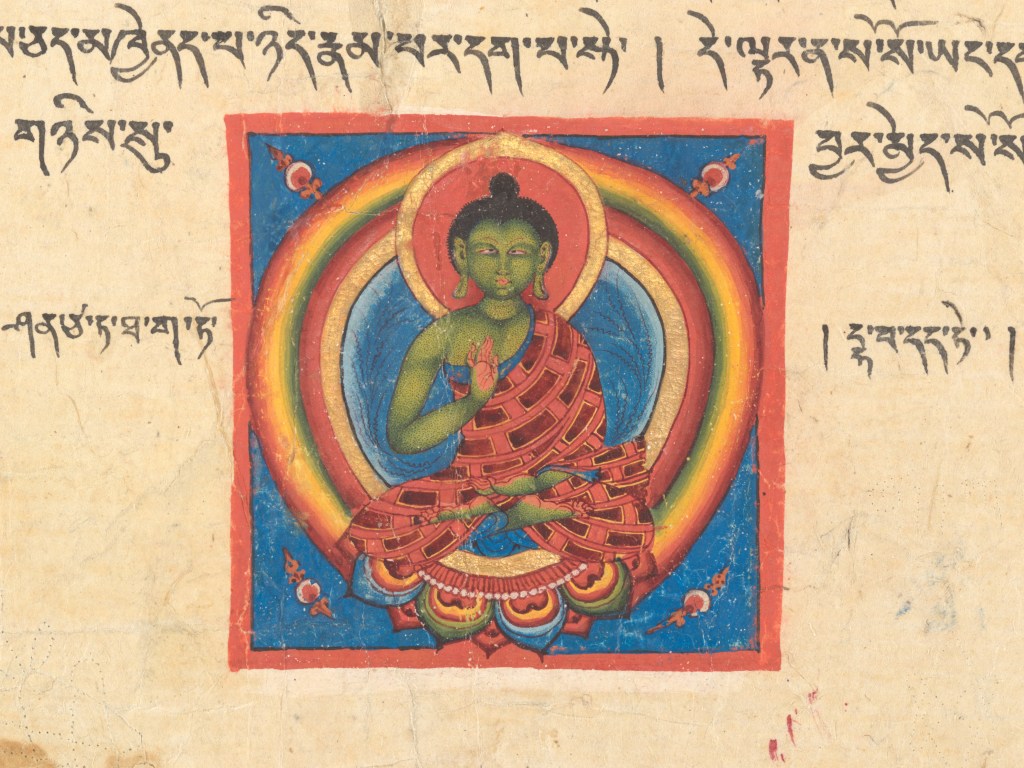
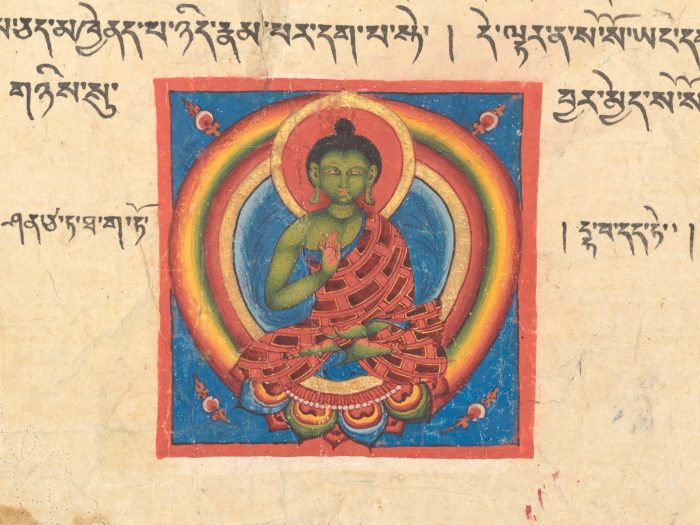
This exquisite example of 12th century western Himalayan manuscript painting embodies the highest qualities of this tradition. Colours are radiant and, thanks to the subtle use of tonal gradation, have a luminosity that enhances the figure’s other-worldliness. It depicts a Buddha with green body seated with folded legs in the lotus pose (padmasana) on a lotus cushion with rainbow colored petals. He may possibly be identified (by his colour) as Amoghasiddhi, the Buddha of the North, or as one of the 1000 Buddhas of the present age (Bhadra Kapla). However, he is shown without crown or jewels, dressed only in the patchwork robe of the renunciant Shakyamuni, so his precise identity remains uncertain. Remarkable is the speckled treatment of his body colour, and the spiky treatment of hair and ushnisha. Similarly remarkable is the treatment of the monastic robe, textually defined as being made from a patchwork of soiled and discarded robes abandoned by their owners, the true mark of a renunciant’s humility and detachment. These are rendered as patches of maroon on a red ground; a under robe of blue is detectable at the shoulder and feet. Wavy lines radiate from the body as it energy patterns. All is enveloped in a rainbow aureole of gold, red, green, yellow and maroon, set against a blue ground.
© The Metropolitan Museum of Art
From: The Embossed Tea Kettle: Orate Gama and
other works of Hakuin Zenji,
by Zen Master Hakuin
Translated from the Japanese by R.D.M. Shaw, D.D.
Click here to read more teachings from Hakuin Zenji.
Share:

Categories: Buddhism, Chan / Seon / Zen, Zen Master Hakuin
 Buddhism now
Comments