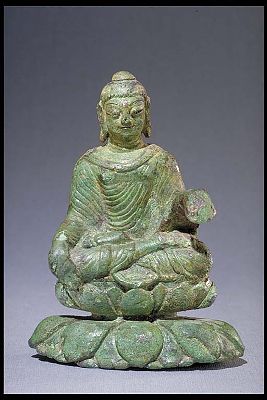
 A remarkable collection of religious items sourced from diverse lands was discovered during archaeological excavations on the Swedish island of Helgö. Located in Lake Malaren, to the west of Stockholm, this small island was an important Viking trading and manufacturing centre (6th-11th centuries AD).
Undoubtedly the most extraordinary find discovered during the excavations at Helgö was a small, bronze Buddha. This devotional figure dates from circa the 6th century AD and was probably made in Kashmir, on the Pakistan/India border. The Buddha has a silver urna on his forehead, symbolizing the third eye, while the ears have long lobes, the insignia of royalty. He sits in a meditative pose upon a double lotus throne, the latter representing purity. The Buddha probably arrived in Helgö via Swedish merchants whose eastern trade routes were concentrated along Russian rivers such as the Volga.
From: Irish Archaeology.
Other views from the Swedish History Museum.


Height around 8.5cm just over 3 inches.
Share:

Categories: Art, Buddhism, Encyclopedia, History, News & events
 Buddhism now
The Cult of Odin and the 9 Noble Virtues mimic the 8 Fold Path closely.
Have you a link Jeffery?
https://www.learnreligions.com/noble-virtues-of-asatru-2561539
The myth goes, Odin gave himself unto himself suffering for 9days on the World Tree to gain inner wisdom and there he learned the secrets of the Runes.
He gave his eye at the well of souls to turn inward to learn the path out of his end and rebirth at Ragnarok, which is a cyclical death of the gods called the Twilight of the Gods.
He is said to roam the earth to this day, seeking those willing to sacrifice for the sake of knowledge.