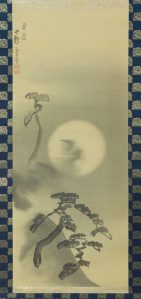
Nagasawa Rosetsu
In the heart of the Buddha’s teachings lies a profound caution: to seek truth is not to entangle oneself in concepts or to cling to views. Words, descriptions, and ideas — while useful as pointers — are ultimately inadequate to capture the depth of reality. The danger is that insights, once grasped, can easily harden into words, those words solidify into descriptions, and the descriptions freeze into fixed views. When this happens, the very wisdom we seek to cultivate becomes obscured, trapped in the rigidity of our own interpretations.
The Buddha, in his great wisdom, recognised this tendency in the human mind. He knew that our natural inclination is to organise and label our experiences, to make sense of the ineffable through language and concepts. Yet he also saw that this process often leads us astray. The words and descriptions we create are but shadows of the true experience, and when we cling to them, we lose sight of the living truth that lies beyond.
Insight, in its truest form, is dynamic. It flows like a river, ever-changing, never fixed. When we grasp at an insight and attempt to fix it in place with words, we risk turning something fluid and living into something static and dead. In the same way that the finger pointing at the moon is not the moon itself, words are not the truth itself — they are only signposts. The Buddha’s caution against clinging to views is a reminder that the ultimategoal of the Dharma is not the articulation of truth but the direct experience of it.
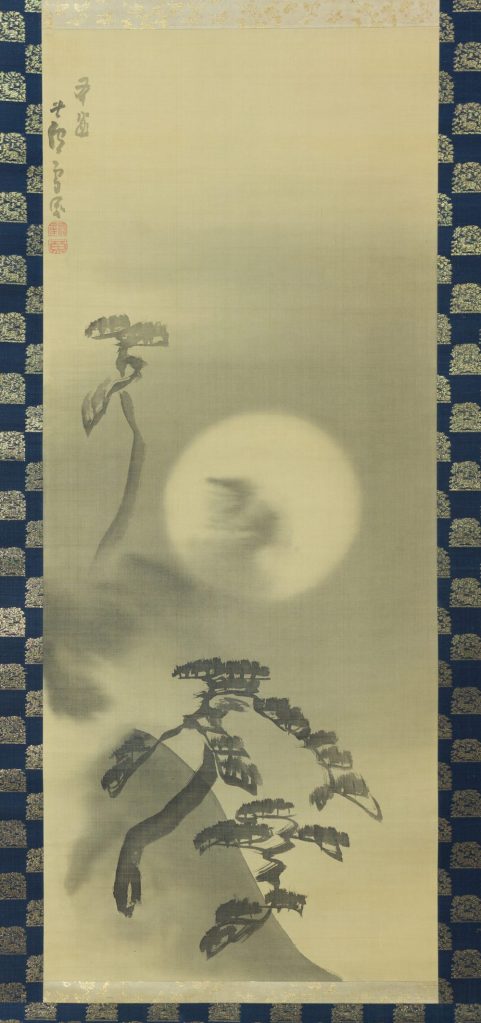
Moonlit Landscape
Nagasawa Rosetsu 長澤蘆雪 Japanese
1794–95
Images of moonlit landscapes were a favorite subject of the artist’s oeuvre from the earliest stages of his career, as attested by the paintings attached to a pair of screens in The Met’s collection (1975.268.72, .73), right up until the end of his career, as demonstrated here. During the last five or so years of his life, beginning when he was travelling to Hiroshima and Itsukushima (site of a famous Shinto shrine) in 1794, he created several permutations of the theme of a full moon with clouds. The most famous example is preserved by the Egawa Museum of Art in Hyōgo prefecture, and two variations on the theme have in recent years entered the collection of the Minneapolis Institute of Art (acc. nos. 2015.79.164; 2013.31.35). In the former, a pine tree in grey wash is silhouetted directly again the moon; in the Minneapolis examples abstract cloud formations resemble a dragon ascending to the heavens or hover over obscured mountain cliffs
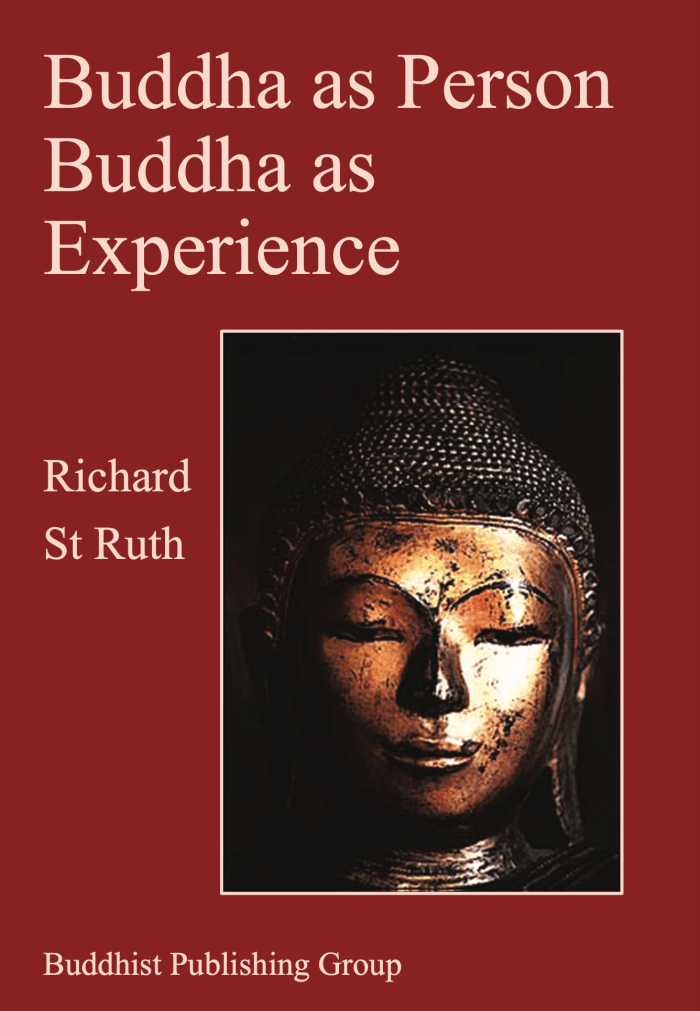
‘In the heart of the Buddha’s teachings lies a profound caution’ is an extract from Buddha as Person, Buddha as Experience. A spiritual travelogue that invites readers on an inner journey guided by the Buddha — one of the most profound figures in human history.
Share:

Categories: Beginners, Buddhism, Buddhist Insights, Everyday Buddhism
 Buddhism now
Comments