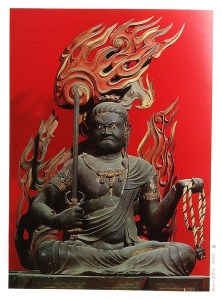
And look at the image of Fudo who is so much in fashion these days. It is meant to be a manifestation of the five duties of life. The rope which hangs on his left arm symbolises the tying up of the illusions of sentient beings so that these illusions may not operate. The sword which he holds in his right hand shows that he cuts off all illusionary ideas of sentient beings. The flame which rises behind him is the symbol of the burning up of illusions. He is standing on the great earth, which shows that he is treading down all illusions so that they may not rise up into the minds of sentient beings. The pure water falling at his side is for the purpose of purifying all illusions. The aspect of his body is that of a fierce deity whose right eye looks up towards heaven, and whose left eye looks down towards the earth. He is standing like an awe-inspiring warrior. All this is an allegory, telling people not to wander away in the senses of this illusionary and transient world.
Gods and buddhas have in reality no form, and as they have no form they are unknown to those who dwell in the realms of the secular life. They have been given form out of necessity. But do not rely on names and forms. If you do, that is illusionary. Not even the buddhas of Embudangon1 have any other origin than on this earth, which is nothing but an accumulation of impurities.
Images:

Seated statue of Fudo Myo-o,
Daigo-ji, Japan
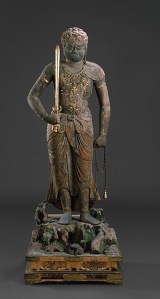
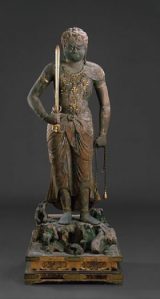
Fudō Myōō (Achala Vidyaraja)
Japan,
12th century
Fudō is the most widely represented of the Buddhist deities known as Myōō, or Kings of Brightness. A fierce protector of the Buddhist law, he is a direct emanation of Dainichi Nyorai, the principal Buddha of Esoteric Buddhism. The first sculptures of Fudō Myōō made in Japan showed the figure seated, but standing examples like this one began to appear in the eleventh century. Fudō uses his sword to cut through ignorance and his lasso to reign in those who would block the path to enlightenment. The heavy weight of the shoulders and back is planted firmly on the stiffened legs, appropriate for a deity whose name means “the Immovable One.” This statue, composed of six hollowed-out pieces of wood, was formerly the central icon at Kuhonji Temple, northwest of Kyoto.
© The Metropolitan Museum of Art
- Embudangon: The Japanese name for the river full of golden sand which flows under the jambu (embu) tree. The land through which this river flows is the continent where there are less pleasures to be enjoyed than in the other two continents of the Buddhist universe, but this (Jambu) continent surpasses the others in real joy because it is here only that one may meet the Buddha and listen to him. ↩︎
From: The Embossed Tea Kettle: Orate Gama and
other works of Hakuin Zenji,
by Zen Master Hakuin
Translated from the Japanese by R.D.M. Shaw, D.D.
Click here for more about Fudo-sama — immovable wisdom.
Click here to read more teachings from Hakuin Zenji.
Share:

Categories: Buddhism, Chan / Seon / Zen, Encyclopedia
 Buddhism now
Comments