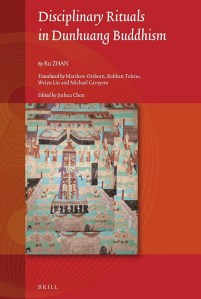
This is a big book, and it contains so much of interest for all Buddhists, not just Buddhist geeks like me. ‘Disciplinary Rituals in Dunhuang Buddhism’, authored by Ru Zhan, edited by Jinhua Chen, and with translations by Matthew Orsborn, Robban Toleno, Weiyu Li and Michael Cavayero is a remarkably comprehensive work that belies its seemingly specialist title. At 763 pages, it offers far more than a mere academic exploration of Buddhist practices at the Dunhuang sites.
What particularly delighted me was discovering that the book’s opening sections — the Preface, Introduction and introductory chapters — alongside the stunning colour photographs of original Dunhuang manuscripts, could easily stand as an excellent publication in their own right. For those of us fascinated by Buddhist history, these images offer a rare glimpse into our spiritual heritage.
Throughout the text, we see how Buddhist discipline evolved naturally to meet both spiritual and social needs. I was particularly drawn to the mention of zhai (齋會), the vegetarian feast gatherings, which beautifully demonstrate how communal practice and doctrinal observance have always gone hand in hand in Buddhist life.
One of the treasures within these pages is the rich selection of translated source materials. There’s a wonderful footnote for instance, that recounts how the Buddha established the summer varṣā (rains retreat). It’s a perfect example of how our practice traditions emerged from real-world concerns — in one case, responding to laypeople’s observations about monks travelling in all seasons and inadvertently harming small creatures. This led directly to the establishment of the rains retreat, a practice that continues to enrich Buddhist communities today.
While the scholarship is impeccable, what makes this volume truly special is how accessible it is. Whether you’re a scholarly researcher or simply a curious Buddhist practitioner, the clear explanations and thoughtful context help make even complex aspects of ritual and discipline understandable and relevant to contemporary practice.
For anyone interested in Buddhist practices, monastic discipline, or the fascinating religious heritage of Dunhuang, this work is a real gift to our community. It bridges the gap between academic research and practical Buddhist understanding, while the beautiful manuscript photographs connect us directly with our spiritual ancestors. This is one of those rare books that grows more valuable the more I dip into it.
Here are a couple of examples.
Certificate for Receiving the Bodhisattva Precepts
![S.1780, Mou yuannian Shah ou Longxingsi shou Youxiang deng pusa jie die' #7 F7)/N*E 興寺授有相等菩薩戒牒「The Certificate for Bodhisattva Precepts to Youxiang and Others at Longxingsi in Shazhou in the First Year (of an unknown era)] Certificate for Receiving the Bodhisattva Precepts On this day, in the first year of [an unknown era], at Longxing Temple in Shazhou, disciple [Youxiang] and others have sincerely sought to receive the Bodhisattva Precepts. The Dharma teaches that the Bodhisattva Precepts are profound and unshakable. Once taken, they cannot be broken. By upholding them, one enters the lineage of the Buddhas and connects with the vows of all bodhisattvas across the ten directions. From this day forth, may those who receive these precepts cultivate compassion, eliminate afflictions, and guide all beings toward liberation. May they uphold the Dharma, practice diligently, and realize the path to enlightenment. With reverence, this certificate is issued as a testament to their commitment. COURTESY OF THE BRITISH LIBRARY](https://buddhismnow.com/wp-content/uploads/2025/03/img_8224-e1741039694174.jpeg) On this day, in the first year of [an unknown era], at Longxing Temple in Shazhou, disciple [Youxiang] and others have sincerely sought to receive the Bodhisattva Precepts.
On this day, in the first year of [an unknown era], at Longxing Temple in Shazhou, disciple [Youxiang] and others have sincerely sought to receive the Bodhisattva Precepts.
The Dharma teaches that the Bodhisattva Precepts are profound and unshakable. Once taken, they cannot be broken. By upholding them, one enters the lineage of the Buddhas and connects with the vows of all bodhisattvas across the ten directions.
On this day, in the first year of [an unknown era], at Longxing Temple in Shazhou, disciple [Youxiang] and others have sincerely sought to receive the Bodhisattva Precepts.
From this day forth, may those who receive these precepts cultivate compassion, eliminate afflictions, and guide all beings toward liberation. May they uphold the Dharma, practice diligently, and realize the path to enlightenment.
With reverence, this certificate is issued as a testament to their commitment.
S.1780, Mou yuannian Shah ou Longxingsi shou Youxiang deng pusa jie die’ #7 F7)/N*E
興寺授有相等菩薩戒牒 [The Certificate for Bodhisattva Precepts to Youxiang and Others at
Longxingsi in Shazhou in the First Year (of an unknown era)]
Certificate for Receiving the Bodhisattva Precepts
On this day, in the first year of [an unknown era], at Longxing Temple in Shazhou, disciple [Youxiang] and others have sincerely sought to receive the Bodhisattva Precepts.
The Dharma teaches that the Bodhisattva Precepts are profound and unshakable. Once taken, they cannot be broken. By upholding them, one enters the lineage of the Buddhas and connects with the vows of all bodhisattvas across the ten directions.
From this day forth, may those who receive these precepts cultivate compassion, eliminate afflictions, and guide all beings toward liberation. May they uphold the Dharma, practice diligently, and realize the path to enlightenment.
With reverence, this certificate is issued as a testament to their commitment.
COURTESY OF THE BRITISH LIBRARY
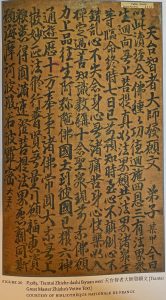
Great Master Zhizhe’s Votive Text
With deep sincerity, I take refuge in the Buddha,
dedicating all my merits and cultivating wisdom.
Through the power of these vows,
I aspire to be reborn in the Pure Land.
No matter the suffering or hardship,
I will always uphold the Dharma,
practicing in accordance with the teachings of the sages.
I vow to reach the Buddha’s land,
where I shall attain perfect enlightenment.
May all Buddhas guide me,
so that I may always remain in their presence.
Tiantai Zhizhe dashi fayuan wen’ 天台智者大師發願文 [Tiantai
P.3183,
Great Master Zhizhe’s Votive Text
COURTESY OF BIBLIOTHEQUE NATIONALE DE FRANCE
Disciplinary Rituals in Dunhuang Buddhism
Series: Studies on East Asian Religions, Volume: 7
Author: Ru Zha Editor: Jinhua Chen
Drawing on Dunhuang manuscripts and the latest scholarship in Dunhuang and Buddhist Studies, this translation analyzes Buddhist monasticism via such topics as the organizational forms of Dunhuang Buddhist monasteries, the construction and operation of ordination platforms, ordination certificates and government ordination licenses, and meditation retreats, etc.
Assuming a pan-Asian perspective, the monograph also made trailblazing contributions to the study of Buddhist Sinicization and Sino-Indian cultural exchanges and is bound to exert long-lasting influences on the worldwide academic study of Buddhism.
Brill
Copyright Year: 2023
E-Book (PDF) Availability: Published ISBN: 978-90-04-51757-8 EUR €163.00
Hardback Availability: Published ISBN: 978-90-04-51407-2 EUR €163.00
Click here for more details and sample pages from Disciplinary Rituals in Dunhuang Buddhism at brill.com.
Share:

Categories: Book reviews, Books, Buddhism, Encyclopedia, History
 Buddhism now
Comments