One afternoon in Topsham, near where l live, l saw a little wooden plaque for sale outside a shop. ‘Wake up and be amazing,’ it said, and l thought ‘I’ll buy that,’ so l did. And l remembered once driving through Bulgaria with a Bulgarian friend, and how he laughed as we passed through a village. He explained that the name of the little town — Buddhi — meant ‘Wake up town,’ and of course the word Buddhism — from the same ancient root — means the way of awakening.
We so often cope with difficult feelings and negativities by shutting down and finding some distraction towards which we can redirect our attention. And so the problem remains and we pretend to ourselves that we have either dealt with the problem or it has gone away, not only leaving it undealt with, but as a focus of all sorts of other similar problems.

We are so used to turning a blind eye to our problems, that we barely notice what we are doing until the next lot of problems surfaces — or even resurfaces. But we are not just ignoring problems and not dealing with them, but ignoring parts of ourselves that need attention and not dealing with them.
There is that strong wish in us to ignore painful things — if possible — but that leaves us bound to them in a kind of sleepy slavery.
So what about waking up — and being amazing — and does it work? Well if you can learn to cope with the discomforts and face the problem, you and the problem can often find a common ground — the underpinning of your human nature that underlies everything and in opening to it brings everything together and begins to lead us to the peace of mind that we all seek.

When we are involved with a problem, it very often pulls us in and seems to fill all the space in our minds, but we also have a natural awareness underlying all this, sometimes described as awareness of awareness (proprioception) which our problems cannot dominate. It is always there, but we usually overlook it. Sometimes, when l have driven some distance and finally stop and sit quietly, there it is. My mind is done with driving and relaxes in quietness. When that happens, l see thoughts and preoccupations coming and going but no longer dominating my thoughts. l am aware of all that without being drawn in. Just for a little while, the mind stops obsessing over thoughts and problems. The mindfulness walking practice does the same thing very effectively l find. At these moments, you realise how conditioned you are to follow nagging thoughts like a servant, with no awareness of an alternative.
It is like throwing a stone into a lake and then another and another and forgetting how the clear, still water once reflected the world around it in peace. We are all guest houses for these visitors, as the great Sufi Rumi put it and we must welcome what comes, otherwise it will return to cause us more problems and as another teacher once said ‘When the carpet is pulled from under your feet, you must learn to dance on air.’
I look forward to that day!
You can read more articles by John Aske here.
Images:
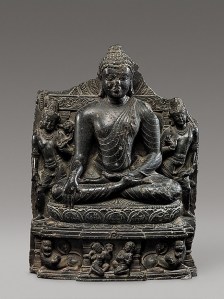
Seated Buddha Reaching Enlightenment, Flanked by Avalokiteshvara and Maitreya
This Buddha from the great monastic site of Nalanda is seen at the moment of enlightenment, with his right hand reaching down to touch the earth, bearing witness to his past refined and meritorious actions, including those in countless past lives that brought him to this point of ultimate realization. The Buddha sits in a yogic posture, deep in meditation. His enlightenment allowed him not only to realize, but also to teach, the Four Noble Truths, as stated in the inscription on his lotus throne:
Of all dispositions proceeding from a cause
The Tathagata [Buddha] has explained the cause
And he has explained their cessation also
This is the doctrine of the great Shramana
[the great ascetic or meditator—the Buddha].
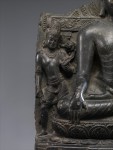
At his right stands the bodhisattva Avalokiteshvara, identifiable by the image of the Buddha Amitabha in his headdress. At his left is Maitreya, the next Buddha who will come in some distant future.
© The Metropolitan Museum of Art.
Share:

Categories: Beginners, Buddhism, Buddhist Insights, John Aske
 Buddhism now
Comments