Q: When the mind reaches the state of not dwelling upon anything, and continues in that state, will there not be some attachment to its not dwelling upon anything?
A: So long as your mind is fixed solely on void, there is nothing to which you can attach yourself. If you want to understand the nondwelling mind very clearly, while you are actually sitting in meditation, you must be cognisant only of the mind and not permit yourself to make judgements — that is, you must avoid evaluations in terms of good, evil, or anything else. Whatever is past is past, so do not sit in judgement upon it; for, when minding about the past ceases of itself, it can be said that there is no longer any past. Whatever is in the future is not here yet, so do not direct your hopes and longings towards it; for, when minding about the future ceases of itself, it can be said that there is no future. Whatever is present is now at hand; just be conscious of your nonattachment to everything — nonattachment in the sense of not allowing any love or aversion for anything to enter your mind; for, when minding the present ceases of itself, we may say that there is no present. When there is no clinging to any of those three periods, they may be said not to exist.
Read a few more posts on Zen master Hui Hai.
From ‘Zen Teaching of Instantaneous Awakening‘ by John Blofeld.
ISBN 9780946672035
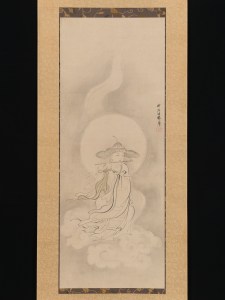
This elegant vision of the bodhisattva Jizō Bosatsu (Sanskrit: Ksitigarbha) playing a flute is a rare and innovative portrayal that may have been created by Kano Tan’yū himself, who, as head of the Shogun’s painting academy (edokoro), was familiar with most of the ancient paintings that had survived to his day. The few similar paintings known of a flute-playing Jizō are by Tan’yū or his followers. The gentle, boyish figure, dancing, playing a flute, and wearing both the traditional monk’s robe and the flowing scarves and jewels of a bodhisattva, combines several aspects of Jizō’s traditional iconography. Instead of lotus petals, he wears a huge, overturned lotus leaf upon his head. His monk’s staff and sacred wish-granting jewel have been replaced by a phoenix-headed flute.
狩野探幽筆 笛吹地蔵図
Title: Jizō Bosatsu Playing a Flute
Artist: Kano Tan’yū (Japanese, 1602–1674)
Period: Edo period (1615–1868)
© The Metropolitan Museum of Art.
Share:

Categories: Buddhism, Buddhist Insights, Chan / Seon / Zen
 Buddhism now
Comments