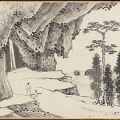
Afterwards, however, as I began reflecting upon my everyday behaviour, I could see that the two aspects of my life—the active and the meditative—were totally out of balance. No matter what I was doing, I never felt free or completely at ease. I realised I would have to rekindle a fearless resolve and once again throw myself life and limb together into the Dharma struggle…
Encyclopedia
Buddhist encyclopedia
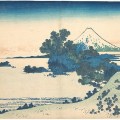
Mishima Pass, Mount Fuji, and the Towering Cypress, by Katsushika Hokusai
Even Mount Fuji in the distance is dwarfed by the monumental tree…
Experience your own Awareness: A Conversation on Chan (Zen) Buddhism with Bill Porter
Short film: A Conversation on Chan (Zen) Buddhism with Bill Porter. About 30 minutes
A taste of Zen: Heze Shenhui
Shenhui thus founded what became known as the Heze (in Japanese, Kataku) school of Zen. The branch largely died out during the early ninth century and is not remembered as a major school. Nevertheless, the doctrine of sudden enlightenment remained a central characteristic that defined the teaching styles and cultural flavour of later Chinese Zen…
Investigation of the Live Word, by Taego Pou
Do not do anything (good or bad) and do not even do this not-doing; then straightaway one reaches that place where there is no concern for external affairs, that vast and peaceful place where there are absolutely no obstructing thoughts…
Virtue, Calligraphy by Hakuin
This oversize rendition of the character for “virtue” (toku 悳) reflects the exuberant spiritual energy projected by Hakuin Ekaku, who was one of the foremost proponents of the revival of the Rinzai sect of Zen Buddhism in late Edo Japan. Originally composed by Chinese historian and scholar of Confucianism Sima Guang (1018–1086), the inscription reads:
Ethnicity and Buddhism in the UK, by Noy Thomson
Ethnicity and Buddhism in the UK, by Noy Thomson (Thai name Mom Rajawongse Saisvasdi Svastis Thomson) at The ‘British Buddhist Landscape —Transplantation and Growth’ conference. Short film, about 17 minutes.
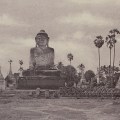
Photographs of India and Burma, 1852-1860 by Captain Linnaeus Tripe
Captain Linnaeus Tripe (1822-1902) was a pioneer of early photography who created an outstanding body of work depicting the landscape and architecture of India and Burma (now Myanmar) in the 1850s. This major presentation of Tripe’s photographs most striking views taken between 1852 and 1860.