‘The condition of a self arises and ceases according to time and place.’ Film around 90 minutes.
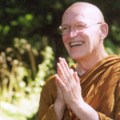
‘The condition of a self arises and ceases according to time and place.’ Film around 90 minutes.
It takes determination to trust this kind of awareness, however, because one’s conditioning tends always to go towards being judgemental and to think in terms of, ‘I shouldn’t feel like this! I don’t know what to do! How should I meditate?’ Whatever you are feeling, however, even if you feel confused about everything, just recognize it ― ‘Confusion is like this’…

Question: An academic friend of mine has done some research and come up with the theory that the historical Buddha didn’t really live, that the Buddhist teachings were of a later period. Is the personality of the Buddha important for… Read More ›

Every one of us has the disease of ‘I’ and ‘mine’, and we absorb more germs every time we see a form, smell an odour, touch a tangible object, taste a flavour, or think in the manner of an ignorant person. In other words, there is the reception of the germ, those things surrounding us that are infected and cause the disease, every time there is sense contact…

This is what we are all involved with. This is what life is for us at this time. We are all alive now, living within the restrictions of our bodies and minds. Whether you like it, approve of it, or whatever, it doesn’t matter…
Extract from a talk given at the Buddhist Publishing Group 2002 Summer School. Around 3 minutes

The matter of “I” and “mine” is the single essential point of the Buddhist teachings. It is the one thing which must be completely purged. It follows that here lies the knowing, understanding, and practice of all the Buddhist Teachings without exception.

Talking about universal love is a very inspiring subject. There is nothing wrong with contemplating universal love, either. But if that’s all we are doing, then it can be merely a whitewash over inner pain and anguish. We might want to love all beings and live in a world of unity and total love. That might be a very appealing idea. What is it that prevents us from that unity? If we trace it back, we will find it’s the ignorance that we have about ourselves…

