As the Buddha walked from the site of his enlightenment towards Benares, seeking to reunite with his five former disciples, he encountered a second ascetic, named Upaka along the road. Also struck by the Buddha’s radiant appearance and serene bearing, Upaka felt compelled to inquire further.
‘My friend,’ Upaka began, ‘your senses seem so clear; your complexion is pure and luminous. Under which teacher have you renounced the world? Who is your guide? Whose teachings do you follow?’
The Buddha went on to explain that he was a conqueror, having vanquished all mental defilements, and had attained a state beyond worldly attachments.
Perplexed by the Buddha’s declaration, Upaka hesitated, unsure how to respond. He simply muttered, ‘It may be so, friend,’ before shaking his head and continuing on a different path, leaving the Buddha to walk his own.
This encounter is significant as it was one of the Buddha’s first interactions after his enlightenment. It illustrates the difficulty in conveying the profound nature of enlightenment to those who have not experienced it themselves. Despite the Buddha’s extraordinary appearance and his claim to have achieved something remarkable, Upaka was unable to fully comprehend or accept what the Buddha was saying.
When asked who his teacher was and what doctrine he followed, the Buddha once again declared that he had no teacher, for he had attained supreme enlightenment through his own efforts. He had ‘conquered all,’ the Buddha said, and was now free from all defilements. Like the ascetic before him, Upaka found these claims hard to believe. In disbelief, he uttered something to the effect of ‘Good for you, friend,’ before turning away and walking down a different path.
Upaka’s reaction is telling. Here was a man actively seeking truth, living the life of a renunciant, yet when confronted with a fully enlightened being, he could not recognise or understand the Buddha’s accomplishment. This reflects a common theme: that true enlightenment, as profound as it is, can appear utterly incomprehensible or even mundane to those who have not themselves tasted such insight. The Buddha’s awakening was not some flashy miracle but a quiet, serene realisation of the nature of suffering, its causes, and the path to liberation. To many, this simplicity was perplexing.
Image:
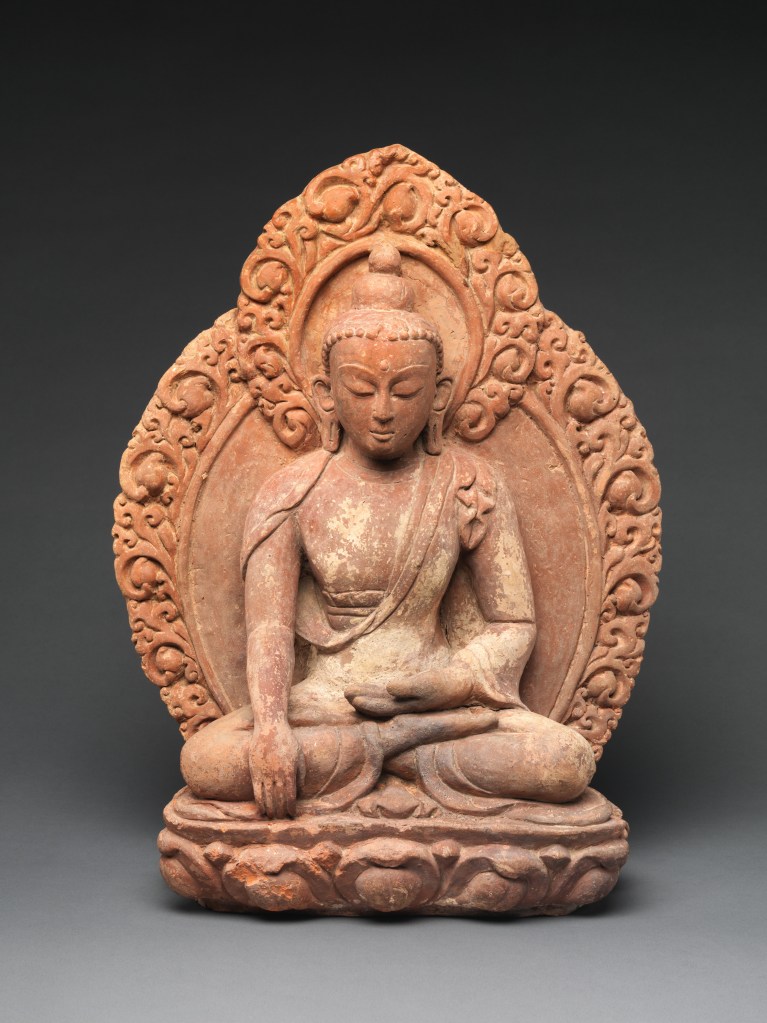
Akshobhya, the Buddha of the Eastern Pure Land
Nepal 16th–17th century
The Buddha reaches his right hand down in bhumisparsha mudra, marking the moment when the historic Buddha Shakyamuni called upon the earth goddess to witness his resistance of the forces of Mara, immediately prior to his experiencing enlightenment. In the Esoteric Buddhist tradition, this iconography is associated with Akshobhya, cosmic Buddha of the East. The lotus buds embellishing the mandorla and the open flower serving as his throne may refer to the celestial abode of Akshobhya. This icon may have been integrated into the wall of a stupa or shrine as part of a set of directional Buddhas.
Akshobhya, the Buddha of the Eastern Pure Land
© The Metropolitan Museum of Art.
‘Returning to the Essence’ is an extract from Buddha as Person, Buddha as Experience. A spiritual travelogue that invites readers on an inner journey guided by the Buddha — one of the most profound figures in human history.

Share:

Categories: An Introduction to Buddhism, Biography, Buddhism, Everyday Buddhism
 Buddhism now
Comments