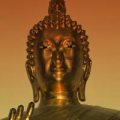
At the beginning each practitioner is given a hua-tou, a kind of koan. For example: What is this? I-Mo-Ko? What is this? The idea is to concentrate your entire attention and mind on this one particular koan or hua-tou: What is this? What is this? What is this? It is different from vipassana meditation where the intention is to be aware and solely aware of what is going on. When you eat, you just acknowledge how that feels—approaching the spoon, touching the spoon, feeling the coolness of the handle, and so on. In koan meditation, however, your attention is single-pointedly directed to this question—What is this?—right now. Initially, it is very difficult to concentrate because all kinds of thinking comes up . . . comes up . . . comes up . . . like clouds, or smoke from a chimney…
Buddhism
The Gold Bar, by Ananda Dulal Sarkar
There were many kingdoms in ancient India varying in physical size and military might. More often than not, the bigger and stronger powers absorbed the smaller and weaker ones by unprovoked military actions. A king always accompanied his army and led it if he belonged to the Kshatriya class…
Emotional Habits, by Ajahn Sumedho
We talk about the doors to the deathless, but it’s not something out there, something remote or hidden. The Buddha pointed to this mindfulness—this is the path to the deathless…
Universal Original Purity, by Ajahn Sumedho
The purity of the moment is in this pure state of awareness. Therefore, you can always refer to it, remember it, just by the simple act of attention, this wide, embracing attention, intuitive awareness in the present. That’s the gate to the deathless, transcendent reality, the unconditioned. It’s not an achievement; you don’t achieve it; you just remember it
The Middle Way, by Buddhadasa Bhikkhu
When the instincts are out of control, they become selfish, and this gives rise to all the defilements. The out-of-control instincts pull the mind off the Middle Way into the dead-end of the kilesa (the mental defilements). This is very important to know…
Direct Knowing, by Ajahn Sumedho
Now the Buddha was a sage who tried to convey a particular teaching that would encourage the realization of ultimate reality. And the teaching of the Buddha sometimes baffles modern humanity because it does seem somewhat strange to our way of thinking; we are used to regarding religion from the point of view of being told something. A sage, or philosopher, or some prophet tells us something, and we either agree with it or not…
The Pain of Attachment, by Corrado Pensa
We fall sometimes, in old habits; we slide back; we regress and start yelling or nourishing self-aversion, but if we keep practising, we wake up again and find that we don’t really want to continue with those old habits. It’s an organic process…
Greetings from Buddhism Now
Season’s greetings from all at Buddhism Now and Buddhist Publishing Group