Recent Posts - page 224
-
The Guru, by Dalai Lama
Wishing the Dalai Lama a happy birthday.
There is a saying in Tibetan: ‘Although your realization is high, like that of a divine being, you should maintain your way of life in conformity with other people.’
-
Vimalakirti Sutra
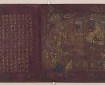
At that time, out of this very skill in liberative technique, Vimalakirti manifested himself as if sick. To inquire after his health, the king, the officials, the lords, the youths, the aristocrats, the householders, the businessmen, the townfolk, the countryfolk, and thousands of other living beings came forth from the great city of Vaisali and called on the invalid. When they arrived, Vimalakirti taught them the Dharma…
-
Happiness in Solitude, by Beopjeong Sunim
Human existence is fundamentally about being alone. We’re born alone, live life as long as we can, and then eventually die alone. Although we may live our lives connected with others, we all maintain our own individual views and belief systems. Just as we each have different facial features, our individual karmic tendencies, which direct our lives, also differ…
-
Ippen’s Pure Land
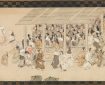
Pure Land Buddhism is one of the major schools in the East, yet has hardly made a dent here. I remember once hearing it being described as too ‘Christian’ for Westerners, yet almost all of the other schools encompass the notion of a Pure Land in some way or other. Even in Theravada the three Refuges can easily be interpreted in a Pure Land way. The very essence of it is that one is taking refuge…
-
We need to put ourselves into perspective, by Ajahn Sumedho
Existence is something that can strengthen us, rather than weaken us. We need to put ourselves into perspective; we need to see ourselves in terms of the mass as well as in terms of the individual. When we take life on the extreme level of ‘me’ as a person, we forget the common problem that we share with the rest of humanity…
-
Scroll of Mudras
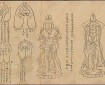
This handscroll depicts hand gestures known as mudras in Sanskrit, the Indian language in which many early Esoteric Buddhist texts were written. In Japan, the gestures are called insō, the Japanese term for a Chinese word that combines the characters for ‘seal’ and ‘form.’
-
Whom do we Believe? by Buddhadasa Bhikkhu
For instance, the Buddha taught that greed, anger, and misunderstanding are the causes that give rise to suffering. If we ourselves are not yet acquainted with greed, anger, and misunderstanding, then there is no way we can believe this. But to believe it would be foolish. When we know ourselves what greed, anger and delusion are like, and that whenever they arise in the mind, they produce suffering like a fire burning us, then we can believe it on the basis of our own experience…
-
Digitising manuscripts at Gangtey Monastery in Bhutan
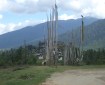
Since the decline of Buddhism in Tibet, Mongolia and other parts of the Northern Buddhist world, the Kingdom of Bhutan has come to be seen as the last bastion of Mahayana Buddhism. With its long history of isolation and independence, Bhutan has remained a unique repository of the cultural and religious wealth of the Buddhist Himalaya. Its secluded monasteries and temples today represent a literary treasure trove that is largely unharmed and still unexplored.
Featured Categories
Beginners ›
-
Compassion is catching by Trevor Leggett.
25 November 2025
-
Awake up sign! By John Aske
21 September 2025
-
The Dharma lies not in the techniques we use, but in the quality of our attention.
3 August 2025
Buddhist meditation ›
-
Morning meditation — Awareness is a natural state; it’s normal.
30 March 2026
-
The object of mind also becomes increasingly subtle and refined.
3 March 2026
-
Morning meditation — Mindfulness in words.
16 September 2025
Foundations of Buddhism ›
-
Awareness and Wisdom (Sati-paññā): Seeing Clearly Through Mindfulness
8 July 2025
-
A Taste of Freedom, by Ajahn Chah
3 December 2023
-
Equanimity, by John Aske
31 August 2023
 Buddhism now