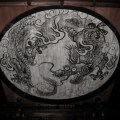
Sutra on expelling evils and begging fortunes. Click any photo to view full size gallery. Date: acclaimed 1745. Language: Yuanyang dialect, Yi language. Photographs from the British Library #endangeredarchives project. Thanks to @bl_eap More posts about the #endangeredarchives project.
Buddhist blog
Om When Drunk, by Trevor Leggett
At present you are occasionally saying it as a sort of insurance policy, paying a little sum now and then and then forgetting about it. But the time will come when there is a crisis, and you will need to practise seriously to find your way out of it. If you then try repeating ‘Om’ seriously, you will find that there are innumerable low-level associations coming into your mind, which will take a good time to get rid of. And you may not have that much time…
The Little Pine Tree.
The little pine tree puts on a show…
Some notes on Tantra, by Francesca Fremantle
It is possible to do any kind of spiritual practice—not only Buddhist, but Christian or other kinds of practices—with a Tantric attitude, with the attitude of seeing the sacredness in life, of relating our ordinary everyday experiences to this kind of sacred experience…
Sermon of No Words, and Anti-Sermon of No Words, by Trevor Leggett
It is a sermon not by exhortation, reasoning or threats but by example…
To Study the Way of Buddha, by Harada Sekkei
The habit of dividing the essential nature of oneness into self and other, life and death, pain and pleasure, rising and falling, and so on, is the source of all delusion and anxiety…
Discomfort without Aversion: A Little Miracle, by Corrado Pensa
You might remember a famous illustration that the Buddha gives of what a healed mind is like. He said, ‘In what is seen, there is only what is seen. In what is heard, there is only what is heard.’…
Buddha, by Ajahn Sumedho
Rather than trying to seek for Buddha or truth (dhamma) in terms of some idea or some doctrinal dogma that we might form around the concepts of Buddha and dhamma, the Buddha pointed to suffering and its cause. By recognising its cause as attachment to desire, we let go. When we let go of the cause, then we realise the cessation of suffering. The Buddha was actually teaching the way of nonsuffering. The Eightfold Path is really the experience of nonsuffering, in the present, in the here-and-now…