Furthermore, Manjusri, what is the Desire-Image Samadhi?
The World-Honored One explained in verse:
“Desire is a mere figment of discrimination,
Which cannot be found.
It does not arise, does not appear,
And has no abode.
By nature, desire is like empty space,
Divorced from anything established.
Because of false discrimination, though,
The defilement of desire plagues the ignorant.
The nature of all dharmas is not defiled;
It is pure, like empty space.
Even if one searches for it
Throughout the ten directions,
No trace of it can be found.
One who knows not this emptiness,
Is terrified to meet desire.
He fears when there is nothing to fear—
How can he ever secure peace and joy?
A fool may be afraid of empty space
And flee from it in terror.
How can one escape from space
When space is everywhere?
The ignorant, being deluded,
Wrongly discriminate.
Desire is intrinsically unreal,
Yet they try to renounce it.
Their efforts are as vain
As the attempt to elude empty space. 1
Every dharma, in its nature,
Is unattainable, like nirvana.
Buddhas of the past, present, and future
All realise the natural emptiness of desire
Secure in this realisation,
They never part from [desire].
Although those who fear desire
Rack their brains seeking liberation from it,
It remains forever intrinsically pure.
When I attained enlightenment,.
I realised that all things are equal.
Some maintain that desire is real
And that it should be abandoned.
The view that desire should be renounced
Arises from false discrimination.
There is, in truth, no abandoning;
It is only [the function]
Of a discriminative mind.
Desire is inapprehensible by nature,
So it cannot be extinguished or destroyed.
In undifferentiated reality,
There is neither liberation
Nor discrimination.
If one could be liberated from desire,
One could also be liberated from empty space.
Empty space and desire
Are boundless and not different.
If one sees any difference,
I tell him to forsake [discrimination].
In truth, desire never arises;
One perceives it because of delusion.
Desire is empty by nature;
It is but an arbitrary name.
One should not engender attachment
Because of such a name.
To realise that desire is free of impurity
Is to realise ultimate emptiness.
Liberation is not reached
Through the destruction of desire.
Desire and the Buddha-Dharma are equal;
This [realisation] is nirvana.
The wise should know:
To enter the realm of utter quiescence
By realising the quiescence of desire
Is called the Desire-Image Samadhi.
The Universal Dharma-door
A Treasury of Mahayana Sutras
Selections from the Maharatnakuta Sutra
大寶積經
Translated from the Chinese by
The Buddhist Association of the United States
Garma C. C. Chang, General Editor
- This indicates that true renunciation of desire can only be attained by realisation of emptiness, i.e., both the emptiness of objects of desire, and of desire itself. ↩︎
Images:
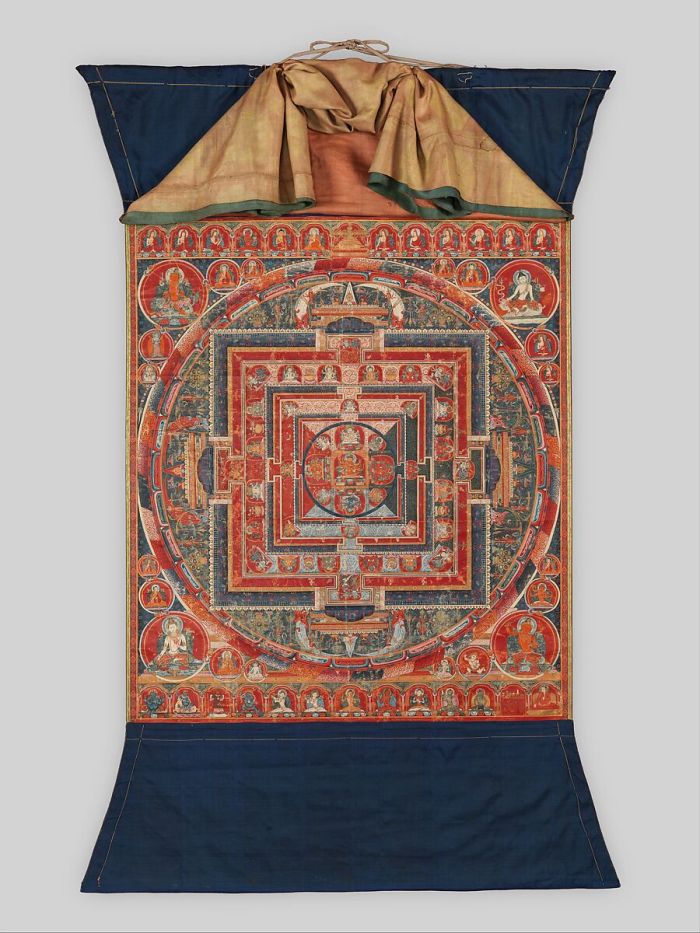
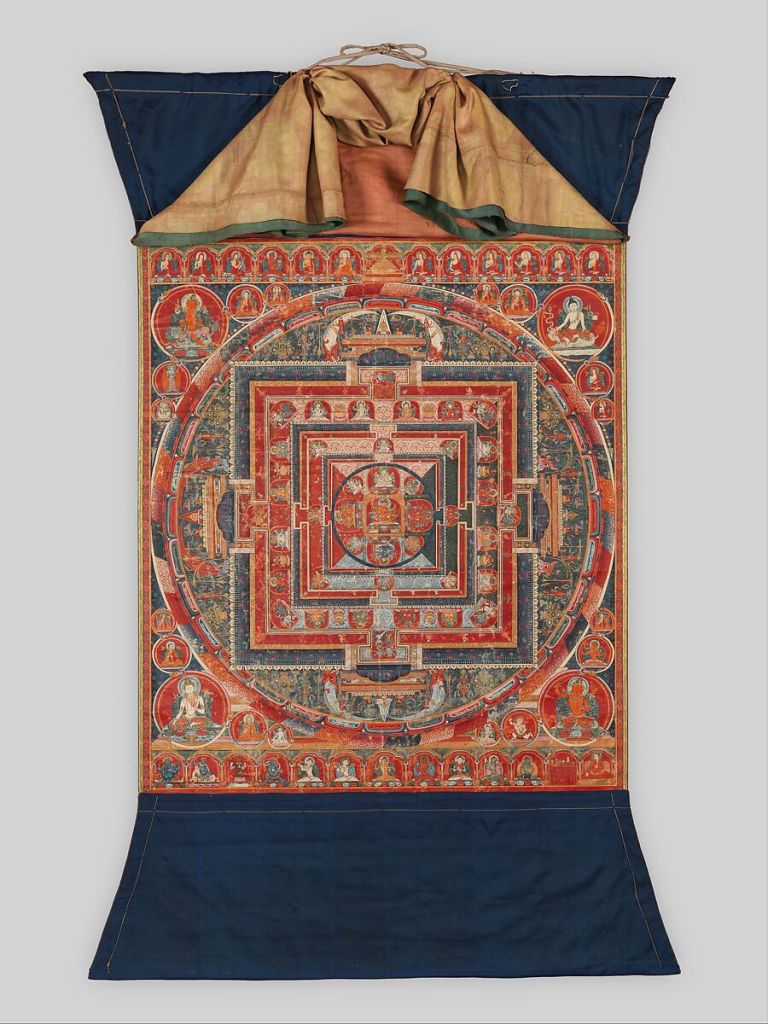
Mandala of the Forms of Manjushri, the Bodhisattva of Transcendent Wisdom, late 14th century, Tibet,
Distemper on cloth; 33 1/16 x 29 1/8 in. (83.9 x 74 cm)
The Metropolitan Museum of Art, New York, Rogers Fund, 1977 (1977.340)
White-Robed Guanyin
China, late 14th century
According to Buddhist belief, Guanyin (Avalokiteshvara, in Sanskrit), Bodhisattva of Infinite Compassion, reveals himself in many forms. In one such manifestation, known simply as the White-Robed Guanyin, the Bodhisattva sits on the rocky island of Putuo (Potalaka, in Sanskrit), believed by the Chinese to be located offshore from Ningbo, in Zhejiang Province.
The Metropolitan Museum of Art
The poem on the back of the scroll was inscribed (from left to right) by Quanshi Zongle:

The body is as small as specks of dust and as ephemeral,
So is the doctrine ephemeral and small as specks of dust;
The world of all living things is but emptiness,
And so Guanyin’s compassionate heart is at rest.

 Buddhism now
Brilliant. Thank you. Not sure why I couldn’t see that.
This is such a stunning teaching. What is the source?
It reminds me so much of Dzogchen teachings. A very similar presentation of Emptiness and form.
with beat wishes in the Dharma
The source is at the bottom of the verse Chodpa.
The Universal Dharma-door
A Treasury of Mahayana Sutras
Selections from the Maharatnakuta Sutra
大寶積經
Translated from the Chinese by
The Buddhist Association of the United States
Garma C. C. Chang, General Editor
R