Short film (18mins) Perspectives on the Awakening Process, by Mahesi Caplan…

Short film (18mins) Perspectives on the Awakening Process, by Mahesi Caplan…

Short video (4mins): ‘An introduction to Zen’

So much of our suffering is around attachment to perceptions, views, opinions and emotional habits. In the enlightened mind one is breaking out of conditioning. Because there is an infinite variety of conditioned phenomena, the Buddha talked in terms of just five groups (five khandhas) in which to get a perspective on it, and this is to be understood in a very direct way, not in a theoretical way. Each one of us experiences through the body, feelings, perceptions, mental formations and consciousness, and…
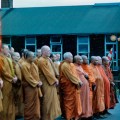
Perhaps this is why Buddhism—almost the oldest of the great religions—has had so little effect on the others…

We have had a problem with our Theme. All’s well now. However, as you can see below, we have lost all of our Twitter and Facebook likes. All things are impermanent. The Buddha

The teacher said that people today, and always, sell themselves cheap. Somebody who is always saying, ‘I’m no good,’ won’t try at anything because, ‘Things always go wrong for me. And if I do happen to succeed in something, it’s never appreciated; it always goes badly. And is life worth living anyway?’ Such people are selling themselves cheap. They have a treasure in them…

To get a glimpse of wishless liberation, we can notice the dissatisfaction—the dukkha—that arises in the heart and mind whenever we want something.

And they dashed in groups! Tea time at Kalachakra was a sight to behold. How else are thirty thousand people going to get their cuppas in such a short time unless it is with great speed? Besides, this was obviously a time-honoured custom and one performed, as with most other things it seemed to me, with joyful vigour…
 Buddhism now