It’s of great importance that we practise the Dhamma. If we don’t practise, then all our knowledge is only superficial knowledge, just the outer shell of it. It’s as if we have some sort of fruit but we haven’t eaten it yet. Even though we have that fruit in our hand we get no benefit from it. Only through the actual eating of the fruit will we really know its taste.
The Buddha didn’t praise those who merely believe others; he praised the person who knows within himself. Just as with that fruit, if we have tasted it already, we don’t have to ask anyone else if it’s sweet or sour. Our problems are over. Why are they over?
Because we see according to the truth. One who has realized the Dhamma is like one who has realized the sweetness or sourness of the fruit. All doubts are ended right here.
When we talk about Dhamma, although we may say a lot, it can usually be brought down to four things. They are simply to know suffering, to know the cause of suffering, to know the end of suffering and to know the path of practice leading to the end of suffering.
This is all there is. All that we have experienced on the path of practice so far comes down to these four things. When we know these things, our problems are over.
Excerpt From
The Collected Teachings of Ajahn Chah – Single Volume
Ajahn Chah
This material may be protected by copyright. Page 88-89
Image:
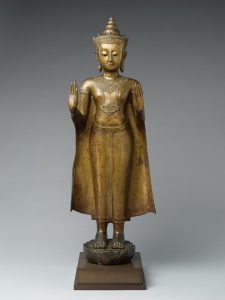
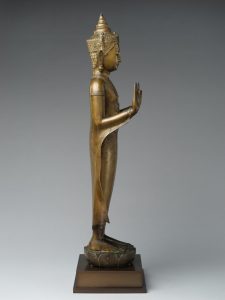
This standing Buddha is a type produced throughout the history of Buddhism in Thailand. The rigidly frontal figure stands with both hands raised, with palms facing outwards, variously gesturing protection (abhaya –mudra), or with the fingers co-joined in the gesture of imparting wisdom (vitarka-murdra). This double-gesture Buddha-type is unknown in India, or elsewhere in the Buddhist diaspora, and appears to have had its genesis in the art of the Mon-Dvaravati regions of later first millennium mainland Southeast Asia. This unique Mon representation was taken up by their Thai successors and became a favored form in which to represent the Buddha. The Buddha wears a distinctive-style diadem closely associated with the later Ayutthaya-period, combined with a cone shaped skull protuberance (ushnisha) that has assumed the form of a tier of honorific umbrellas, each of diminishing size, replicating those seen at the summit of Thai stupas.
Standing Crowned Buddha gesturing protection
Thailand, Ayutthaya or Bangkok
18th century
© The Metropolitan Museum of Art.
Share:

Categories: Ajahn Chah, Beginners, Buddhism, Theravada
 Buddhism now
Comments